
Authors Posts by comms

comms

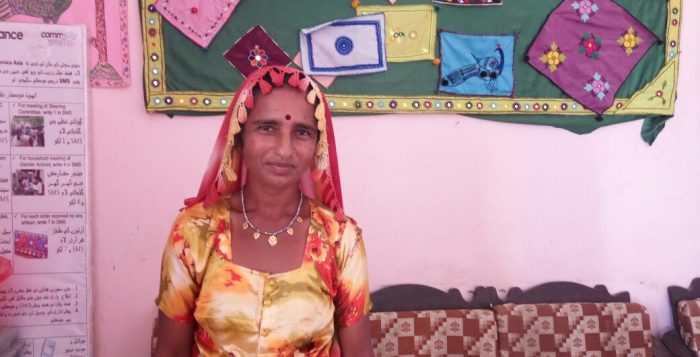
Kanwal, 20, is an artisan from Thatta in rural Sindh.  She is one of eight family members, who struggle to make ends meet with an average monthly household income of around Rs. 7,000 (approximately DKK 448).  Most of her family members work as laborers in the field. “Low income has always remained an issue in our family, and often it caused conflict among family members,” she explains. “Because the income is low and the family is large, it is always difficult to pay for clothes, meals and other things.”

Kanwal is the only member of her family who is learning a new skill to earn an income.  “I feel peace of mind while doing embroidery.  Basic stitches, such as running stitch, I learned from my mother and grandmother.  Right now, I have learned some stitches like mirror work, hormuch and filling stitch at the VTC [Vocational Training Center], and embroidery finishing.”

Traditional Sindhi crafts are extremely important to the people in the region.  Kanwal explains that wearing these traditional handicrafts gives people pride in their identity.  Through her involvement in the project, Kanwal can share this artistic heritage through different designs.  “It is my passion to continue working in this project and improve my skills,” she says.  Working with design students of the Indus Valley School in Karachi, has enabled Kanwal to explore a range of new skills and abilities.  She has learned about product ranges, color palettes, different types of material, measurements, pinning and tracing. “It was a good opportunity for me,” she says.  “I really enjoyed [the students’] company and working with them during the design workshop.  I very much liked the institute, it was big and neat.  It seems like a dream that a visited there.”

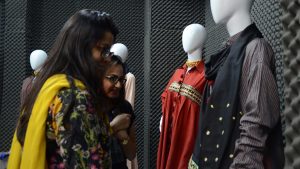
Kanwal’s favorite experience from the project so far has been participating in the Danish Embassy’s “Innovative Denmark” event, where she showed visitors how to do traditional stitches and shared her skills.  “It has really helped me in raising my confidence,” she says.

Kanwal’s family is also excited about her participation in the project, and are confident that she will be able to earn an income with her developed skills.  An alternative source of income is vital to these communities, who are so reliant on agriculture, an increasingly fragile sector.  She explains the importance of extra income for her family, who are affected by frequent flooding in the area.  “In crop season, I have to work with my family members for twelve to sixteen hours daily under frequently harsh and unhealthy conditions to earn some money and store something for the following year to survive, which is now becoming challenging because of flooding.”

This project, which is supported by the Danish Centre for Arts and Culture and the Danish Embassy in Pakistan, is supporting artisans like Kanwal to enhance their opportunities and protect themselves from such financial shocks and is empowering them to combat poverty for themselves and their families. Under the project, rural artisans are working in collaboration with design students of renown design institutes in Karachi, Pakistan, to learn contemporary designs and stitching techniques to cater to the trending market demands as well.

What is the project?

The project aims to support families affected by recurrent floods who have been left with food shortages and minimal income opportunities as agricultural gains have been washed away.

Target groups:

  • Vulnerable households frequently affected by the floods
  • Flood-affected women engaged in kitchen gardening and other income-generation activities
  • Small landowners (who own up to six acres of land) and sharecroppers who have lost their crops during the recent and previous floods
  • Flood-affected landless labourers
  • Socially and religiously marginalized disaster-affected communities
  • Direct Target Groups: 1,535 households (including 625 women-headed households), or 7,675 individuals
  • Indirect Target Groups: 300 households, or 1,860 individuals who will indirectly benefit from the rehabilitated agriculture infrastructure

Achievements so far:

  • Introduction of IRRI-6 rice crop, a saline tolerant crop which will eventually increase resilience of rice planted in saline-affected fields and protect farmers from damage and loss of crops
  • Each family received three 20kg bags of certified rice seed
  • Each family received one 20kg bag of organic fertilizer, sufficient for cultivating two to three acres of land
  • Orientation on integrated crop management techniques and disaster resilient farming techniques for affected farmers
  • 600 women-headed households received kitchen gardening seeds and tool kits
  • Cash grants and disaster risk reduction sessions support local resilience and capacity to effectively cope with the future disasters
  • Promotion of women’s empowerment and food diversity through kitchen gardening

Community World Service Asia is working with communities in rural Sindh to empower women.  With support from UK Aid and Y Care International, we are training women in vocational and literacy skills to improve their opportunities and combat poverty.  However, in order for women to be able to fully realize their potential, their rights need to be recognized, supported and upheld in their homes and throughout the wider community.

We are working to promote gender equality by highlighting some of the key issues which affect women in this area, including domestic violence and child marriage.  Theater is a powerful tool to approach these difficult topics, as it provides entertainment, can reach a large number of people, and can engage an audience in themes which are relevant to them, overcoming limitations such as low levels of literacy.

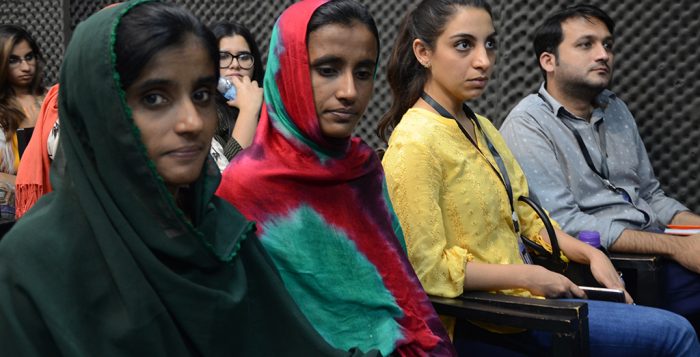
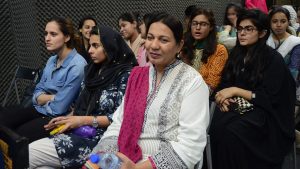
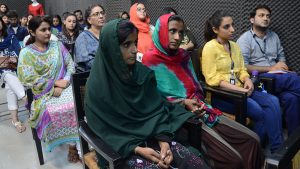
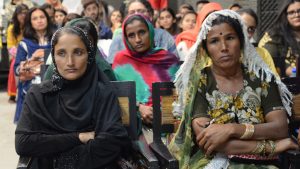
More than 60 community members, social workers, civil society activists and students came to watch a performance which was organized and held by local gender activists who are being trained and supported to raise awareness of gender issues through the project.

The play followed the story of a character called Neela, who was married at the age of twelve.  Although the legal minimum age for marriage in Pakistan is eighteen for boys and sixteen for girls, poverty and insecurity mean that many girls are married at a young age.  Through Neela’s character, the audience saw the impact of a decision made by her father, without the involvement of Neela herself or any other family members.

Neela was forced to drop out of school before progressing on to grade six, so that she could go and live with her new husband and his family.  In her new home, she experienced domestic abuse, both physically and mentally. When Neela returned to her parents’ home, the performers stopped the play and invited the audience to decide how to address the situation. This kind of interaction is extremely engaging for the audience and helps them to relate the themes of the performance to their own situations.  The audience suggested that Neela should file a case in court under Sindh’s Child Marriage Act.

The play was able to share the reality of gender inequality with the audience, and to highlight the violations of rights that are caused by practices such as child marriage. Ms Lachmi, one of the performers, explained the importance of highlighting issues relating to gender justice in the community.

“We women should be strong. We are not only the machines of producing children, but all women can stand with men shoulder to shoulder.”

Community World Service Asia’s Capacity Institutionalization project (CIP) continues to provide trainings and technical assistance resources that caters to the requirements of civil society organizations. In an effort to build the capacity of local humanitarian and development organizations and to expand the use of evidence-based practices, Community World Service Asia hosted two networking events in Islamabad and Lahore in the month of June.  Participants from different organizations shared their learnings, success stories and future implementation and partnership ideas in this event.

The first networking event took place in Lahore. Representatives and participants from various organizations attended the session and explored new possible partnerships. Organizations of the same professional community got to know more about each other’s’ work, upcoming trainings and how to participate in them, areas of priority and published work.

The second event of the same nature was held in Islamabad with the aim to promote the trainings the organization offers on various topics on organizational development and humanitarian quality and accountability at national and regional levels among the aid sector in Islamabad.

Participants Tête-à-Tête

FarkhandaDr. Farkhanda Ather – Mercy Corps

“This was an interesting event, which provided an opportunity to know the local NGOs as well as the diversified scope of work of Community World Service Asia”

NobaNoba Anil- Community Advancement Society

“This networking event was very useful, because it gave us a chance to interact with different organizations. These kind of networking events are beneficial for developing relationships between humanitarian organizations.”

mahrukhMahrukh Saleem – Plan international

“We got to find out a lot of helpful information regarding trainings today. This will  help us in enhancing the capacity of our organization’s staff. Moreover, the  event was very interactive and it provided an opportunity for organizations at all levels to get to  know each other.“

Hafeez AhmadSHafeez Ahmed- Human Rights Commission of Pakistan

“The session on Community World Asia’s work, domain and focus areas was quite an informative one. It is good for new learners as well as for those who are running their own CBOS and NGOs to get this sort of information. Vital information about upcoming trainings, their procedure to participate, very important themes like project management and financial management were covered. This session serves as a key for new avenues of development especially for those who are eager to do something in future.”

TariqTariq Rahim- ACF (Action Against Hunger) International

“It is a great experience of working with Community World Service.  They always bring us together and provide us with an opportunity to sit together and share ideas.  The event was a successful platform for networking.”

Photo: http://www.samaa.tv/

At least 43 people, including eight security officials, have reportedly died after the westerly wave of monsoon rains entered the Khyber Pakhtunkhwa (KPK) province of Pakistan late on Saturday night. The district of Chitral in this northern part of KPK has so far been the worst hit by the flash floods that followed soon after the rains.

As many as 17 people are reported missing in Ursoon Village of Chitral while many more have been injured as clouds of water burst into the area.

The continuing heavy rainfall destroyed around 30 houses in villages near the Pak-Afghan border.

Monsoon rains in Pakistan began late Saturday and continued to shower for hours, with hard-hitting rain covering the KPK province the most. KPK has been most affected by monsoon flooding in Pakistan in the recent years.

Pervez Khattak, Chief Minister of KPK Province, declared red alert in the flood hit areas of Chitral and has announced monetary compensation for the flood affected families.

Community World Service Asia is currently monitoring the situation. The organization’s emergency response team is ready and will start emergency relief activities if required.

Contacts:
Muhammad Fazal
Associate Director
Emergencies/DRR/Climate Change
Email: fazil.sardar@communitryworldservice.asia
Cell: +92 332 5586134

Palwashay Arbab
Head of Communications
Email: palwashay.arbab@communityworldservice.asia
Cell: +92 42 3586 5338

Sources:
www.tribune.com.pk
www.samaa.tv

Today on World Refugee Day the number of displaced people is at it’s highest ever. Though the impact of this refugee crisis will be felt for many years to come but we will continue to look for ways to contribute.

We must address this global crisis with sustainable solutions to empower refugees with dignity and opportunities.

On this day lets stand #WithRefugees as one community, beyond beliefs and borders.

Click here to download infographic

4045

Strengthening financial management skills in small-scale organizations

A proper understanding and application of financial concepts is becoming essential to professionals working in the nonprofit sector as donor agencies increasingly prefer organizations that have good financial management systems in place. Held from 10-13th of May in Peshawar, this three-day training is the second of its sort specifically designed and organized by Community World Service Asia to strengthen the financial management skills of participants belonging to small-scale organizations. The training aimed to equip participants with knowledge and skills to help them utilize financial management tools efficiently. It was attended by a total number of 23 participants comprising of six women and seventeen men from nine organizations.

The training imparted specific skills on the fundamentals of financial management such as developing effective financial policies and internal controls, streamlining accounting system as per organizational policies, preparing budgets, preparing financial reports as per donor requirements as well as facilitating audits to ensure transparency.

Masood Ahmed, the trainer, helped the participants in developing projects and consolidated budgets using activity-based budgeting techniques, simple cash flow forecasts and learning to use them. The significance of financial policies and procedures was highlighted.

Participants got a clearer understanding of the financial management roles and responsibilities of board members, managers, finance team, and program staff. They became better aware of the importance of budgets in planning, control, and decision-making, the key components and language of accounting systems and the link between budgets, accounting records, and financial reports. One of the participants Shahzad From SSEWA PAK said, “The resource person had full command on the topics discussed and had a grip on the entire session.” Another participant, M. Akbar from Dehi Ijtimai Tarqyati Social Workers Council (DITSWC) said that he appreciated the resource person’s way of handling participants working in both finance and programs and found the session inspiring.

Furthermore, brainstorming, individual exercises, lectures, role-plays, group work, interactive discussions, power point presentations were conducted while handout materials were distributed and discussed with all participants.

Twenty members of sixteen Village Disaster Management Committees (VDMCs) established by Community World Service Asia in rural Sindh visited the Pakistan Meteorological Department in Karachi this May.  The members of this hazard-prone community, which is regularly and severely affected by seasonal flooding, were able to observe the ways in which the government department processes and responds to information on weather, climate and geophysical phenomena with the aim of ensuring safety in the air, land and sea. They also observed how these measures mitigate the impact of climate change on agriculture, the main source of employment and income in the province of Sindh.

Chief Meteorologist, Abdul Rasheed, and his colleague, Sarfaraz, introduced the visitors to the effects of climate change, weather forecasting and early warning systems for heavy rains, heatwaves and flooding.

“It’s a matter of great pleasure for us that Community World Service Asia is taking such brave steps to educate communities at a grass-root level,”

Rasheed shared. “The role of DDMA [District Disaster Management Authority] should be strengthened to reduce disasters at the local level, however our unconditional support is always there.”

Gul Hassan, a VDMC member, added,

“It is a good opportunity to learn how government machinery works. We would also like to request the Chief Meteorologist and his team to educate us in the villages.” 

Hanif Nooh Waliro, another VDMC member, said,

“We have learnt a lot; although the presentation was quite tricky, visiting observatory stations was very informative.”

With support from Christian Aid, Community World Service Asia is working to empower local communities to take action so that they can protect themselves from the impact of natural disasters.  Activities such as this visit enable community members to learn about the causes of natural disasters and the mechanisms which are in place to anticipate them. Such activities build links between government departments and local organizations which contribute to effective coordination for preparedness.

NTRODUCTION

The Livestock Emergency Guidelines and Standards (LEGS) are a set of international guidelines and standards for the design, implementation and assessment of livestock-based livelihood interventions to assist people affected by humanitarian crises. The LEGS handbook was first published in April 2009 with the second edition published in 2015, and a series of Training of Trainers (TOT) courses are being rolled out worldwide. The TOT trains participants to be able to deliver the 3-day LEGS training course. To date, the LEGS Project has run 21 TOTs, training over 360 people.

Applications are now invited for a cost-share LEGS TOT in Bangkok, Thailand. The TOT runs for 6 days, from 26th September to 1st October 2016. Participants may apply for the first 3 days of the course (26-28th September) if they are only interested in the LEGS training course rather than the training of trainers..

WHAT IS A LEGS TRAINER?

On completion of the 6-day training of trainers course, trainees become ‘LEGS Trainers’ and are equipped to carry out the 3-day LEGS Training Course in their own country or region. They will have spent 3 days being trained on the LEGS approach and 3 days being trained in adult learning and how to train others in the LEGS approach.

For more details please download brochure and application form