Are you working in humanitarian or development operations and looking to strengthen your supply chain knowledge and practical skills?
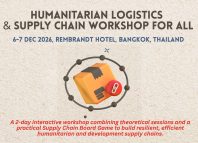
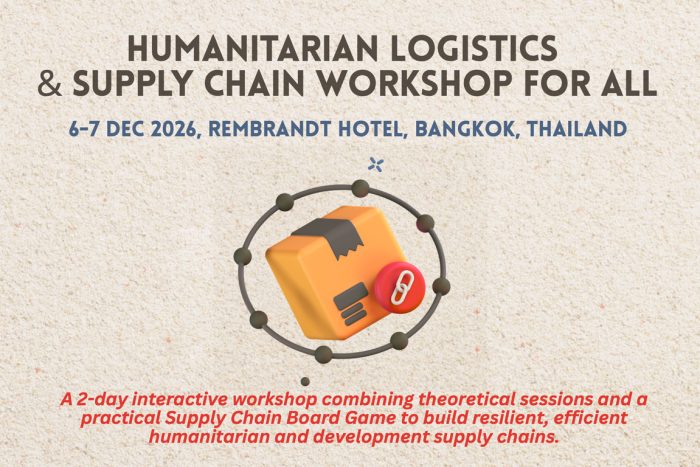
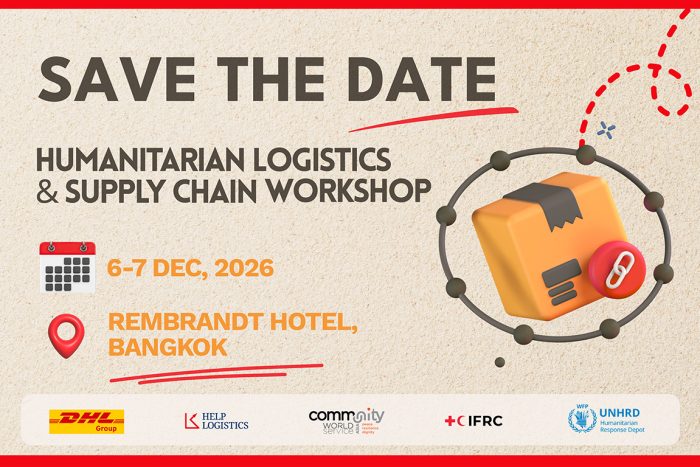
Community World Service Asia (CWSA), in partnership with HELP Logistics, is organising a 2-day interactive Humanitarian Logistics & Supply Chain Workshop on 6–7 December 2026 at the Rembrandt Hotel, Bangkok, Thailand.
The workshop will combine theoretical learning with practical and interactive sessions, including a Supply Chain BoardGame, covering key areas such as:
Humanitarian Logistics Principles & Practices
Human-Centred Design for Supply Chain Solutions
Supply Chain Readiness Assessment
And more
Application deadline: 10 September 2026
Interested participants can register through the registration link provided below or by scanning the QR code in the attached brochure.
We encourage interested colleagues and organisations to apply and take this opportunity to strengthen their capacity to build more resilient and efficient humanitarian and development supply chains.
When crisis strikes, inclusion cannot be an afterthought.
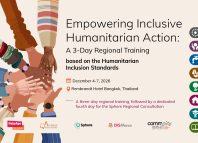
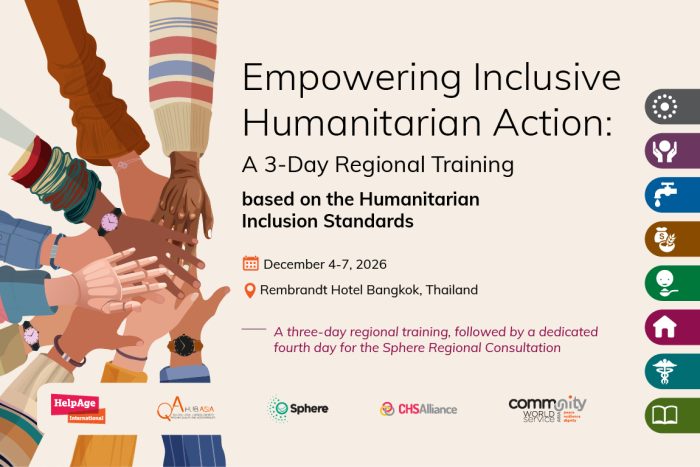
Community World Service Asia, in partnership with HelpAge International, ADRRN’s Q&A Hub, Sphere, and CHS Alliance, invites humanitarian professionals across the Asia-Pacific to a regional training on making inclusion central to humanitarian response, not an add-on to it.
Older people and persons with disabilities are too often overlooked in emergencies, despite the disproportionate risks they face and the valuable knowledge they bring. This training puts a practical framework in your hands, the Humanitarian Inclusion Standards (HIS), aligned with the Core Humanitarian Standard and the Sphere Handbook , to turn “leave no one behind” from principle into practice.
By the end, you’ll be able to: ✔ Make the case for age, disability and gender inclusion in humanitarian response ✔ Recognise how intersecting identities shape people’s experience of crisis ✔ Apply all nine HIS standards across the programme cycle ✔ Identify concrete steps to strengthen participation and accountability ✔ Assess and improve inclusive practice within your own organisation
Who should join: Local and national NGOs, CSOs and CBOs, Older People Associations (OPOs) and Organisations of Persons with Disabilities (OPDs), INGOs, UN agencies, and government stakeholders, including Inclusion Advisors, Programme Managers, Technical Coordinators, and MEAL staff.
Facilitated by inclusion experts Shahzado Khaskheli (Foundation for Ageing and Inclusive Development) and Benil Thavarasa (HelpAge International), each bringing over 20 years of experience in inclusive humanitarian programming.
A dedicated fourth day (7 December) is set aside for the Sphere Regional Consultation.
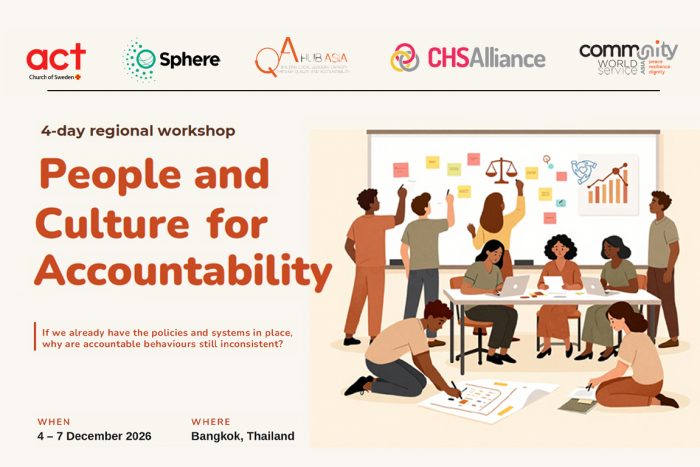
If we already have the policies and systems in place, why are accountable behaviours still inconsistent?
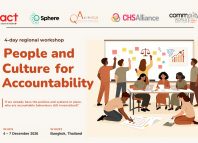
Community World Service Asia, invites aid and civil society organisations to a regional workshop that looks at accountability from the inside out, through People and Culture practice.
This is where policy alone runs out of answers. How are people managed? How are decisions made? How is feedback handled? How is power used and checked? Because when there’s a gap between an organisation’s stated values and its everyday behaviour, that’s where accountability quietly breaks down.
Over four days, participants will examine workplace culture, staff wellbeing, leadership, fairness, inclusion, safeguarding, and performance management, not as separate boxes to tick, but as connected parts of one system. Expect honest peer exchange, practical tools, and real organisational scenarios, not abstract theory.
Key topics include: ✔ Organisational culture as everyday practice ✔ From policy to practice: safeguarding, complaints and staff voice ✔ Change, workload and wellbeing ✔ Performance, feedback and growth ✔ Managing up and responsible challenge ✔ DEI in practice
Who should join: HR/People and Culture staff, QAS focal points, senior managers, and MEAL professionals. We recommend organisations send at least two participants — reflection and change go further when colleagues can apply what they’ve learned together.
Facilitated by Uma Narayanan, an independent consultant and evaluator with extensive experience in accountability, organisational development, and workplace culture across Asia, Africa and the Pacific.
We know the standards. We have the policies. Now what?
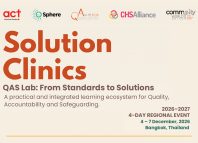
Community World Service Asia, together with its key quality and accountability partners, invites humanitarian and development practitioners to a new kind of learning experience, one built not around another training, but around real problem-solving.
The QAS Lab’s Solution Clinics bring together humanitarian and development practitioners and standards specialists, from across the region to tackle the everyday dilemmas of Quality, Accountability and Safeguarding from “policies without implementation” to “collective accountability to affected populations” and “exit without harm.”
This isn’t a one-off event. It’s a continuous learning journey, from coaching and needs-mapping (Sept–Dec 2026), through four days of hands-on, expert-facilitated Solution Clinics in Bangkok, to sustained mentoring and community-building through mid-2027.
What you’ll gain: ✔ Practical tools to move from compliance to real-world implementation ✔ Confidential coaching on your toughest QAS challenges ✔ A growing QAS Toolbox of job aids, SoPs and checklists ✔ A regional community of practice that lasts beyond the event
Facilitated by Sylvie Robert, a certified trainer and workplace misconduct investigator with 30+ years of experience across the humanitarian-development-peace nexus.
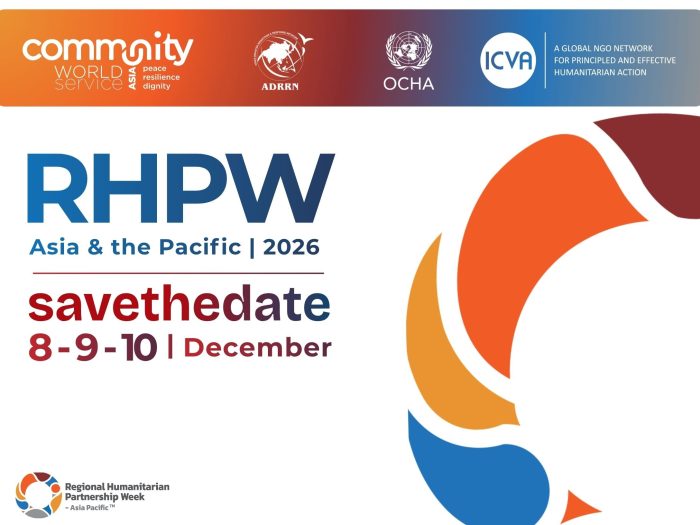
The Regional Humanitarian Partnership Week (RHPW)Asia and the Pacific is officially returning for 2026! On behalf of the co-organisers ADRRN, CWSA, ICVA, and UN OCHA, we invite you to save the date for the region’s premier collaborative humanitarian gathering.
📅 Dates: December 8–10, 2026 📍 Location: Bangkok, Thailand (In-person at the Rembrandt Hotel)
Key Theme:
As the Asia-Pacific sits at the absolute cutting edge of climate risk, geopolitical shifting, and local humanitarian innovation, RHPW 2026 will serve as a dynamic launchpad. We are moving beyond passive discussions to position our region as a primary driver of a completely reimagined, equitable, and locally-led global aid system.
Our strategic dialogue this year centers on three interconnected pillars:
A Changing Landscape: Navigating shifting geopolitics, resource constraints, and new operational realities.
The Climate-Humanitarian-Development-Peace Nexus: Scaling up anticipatory action, local adaptation, and direct-to-local financing.
Shifting Power, Shaping Futures: Ensuring local actors, women, youth, and marginalised groups genuinely lead responses.
Call for EOIs & Registrations: The Call for Expressions of Interest (EOIs) to host sessions is now open! Official registration will launch on Monday, July 20, 2026. Keep a close eye on your inbox, bookmark our website, and follow our social media channels for the registration and application links.
Registration Fee: Historically, RHPW has been fully subsidised. To ensure financial viability and equitable regional execution in a shrinking funding landscape, a nominal registration fee of USD 30 (inclusive of all processing and bank charges) will be introduced per participant for the full three days.
Process Note: Registration serves as an initial expression of interest and does not guarantee a slot. Official confirmation is strictly contingent upon successful verification and receipt of the fee to ensure fair delegation representation.
We are pleased to announce the Humanitarian Logistics & Supply Chain Workshop, taking place on 6–7 December 2026 at the Rembrandt Hotel, Bangkok, Thailand.
The workshop will bring together humanitarian practitioners, logistics experts, and supply chain professionals to exchange knowledge, explore emerging challenges, and strengthen collaboration for more effective, efficient, and resilient humanitarian response.
Please mark your calendars and reserve the dates. Further details, including the agenda and registration information, will be shared in the coming weeks.
📅 Date: 6–7 December 2026 📍 Venue: Rembrandt Hotel, Bangkok, Thailand
We look forward to welcoming you to two days of learning, collaboration, and knowledge exchange.
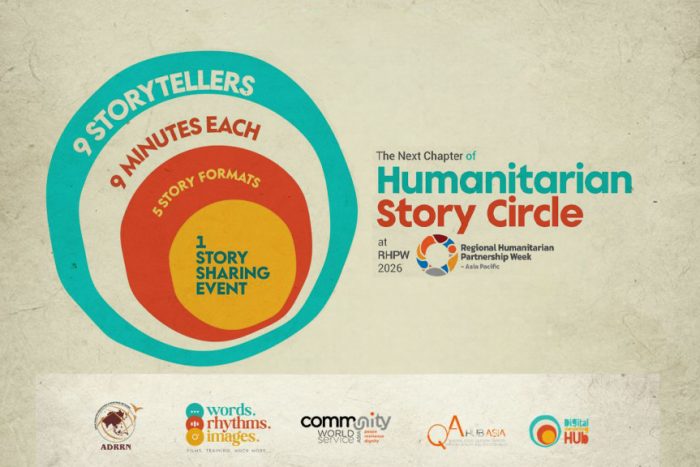
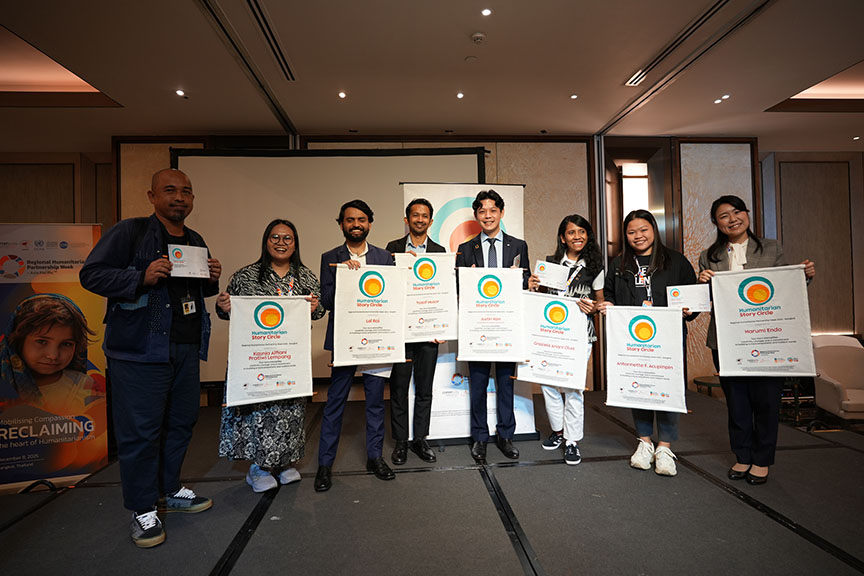
Humanitarian Story Circle (HSC), an exciting storytelling showcase at Regional Humanitarian Partnership Week – Asia & The Pacific (RHPW) in Bangkok, has returned where you can submit and share a story of resilience, struggle, and change along with local humanitarians, community leaders, and civil society from across the Asia-Pacific region.
9 storytellers will be selected to present their work there. Submissions in all formats are welcome, including video, audio, photo essays, spoken word, creative writing, digital art, and in all languages.
Participants will also have the opportunity to attend training sessions covering the fundamentals of storytelling for social change, crafting authentic narratives, and receiving expert feedback to strengthen their stories.
This HSC showcase is proudly organised by Quality and Accountability Hub, led by Community World Service Asia and the Asian Disaster Reduction and Response Network (ADRRN)’s Digital Storytelling Hub, led by words. rhythms. Images.
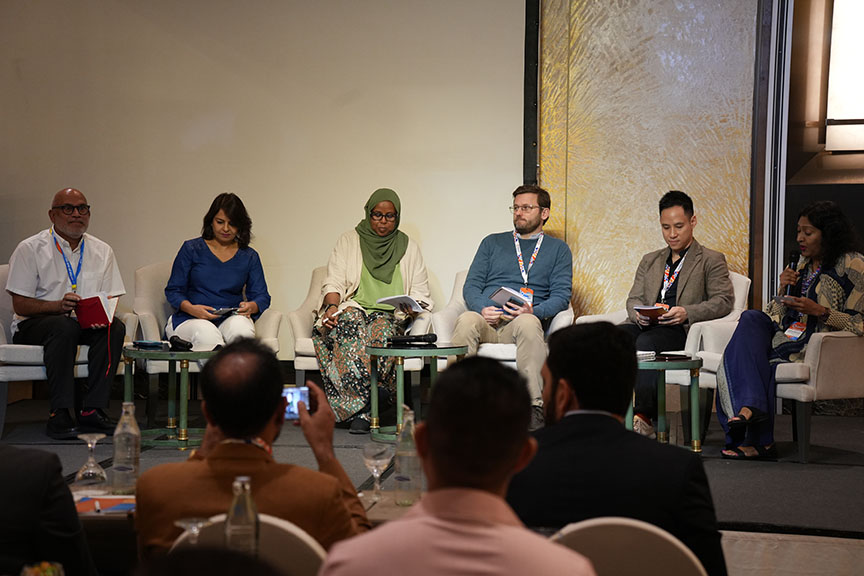
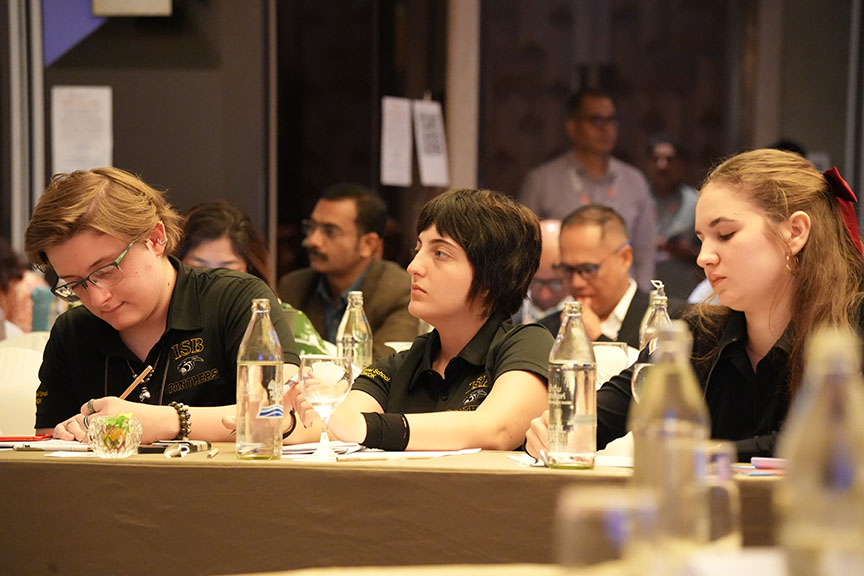
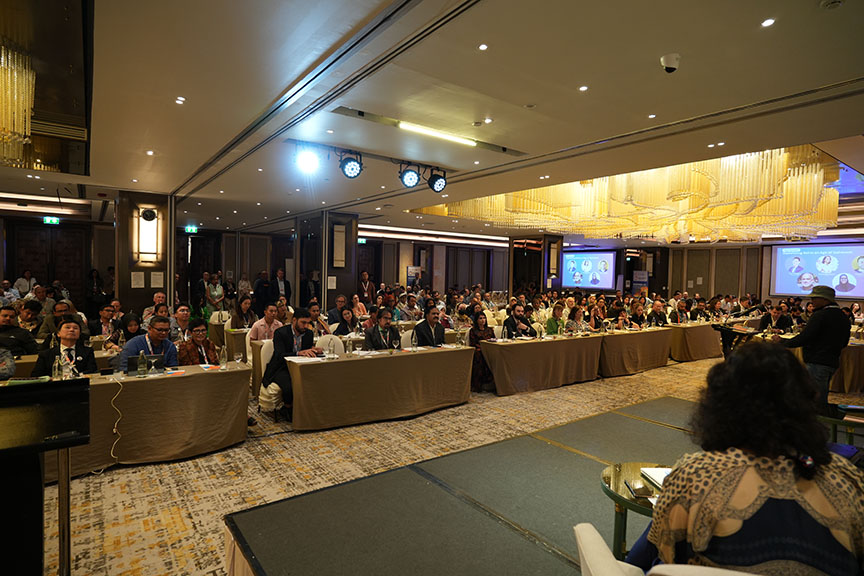
Bangkok, 10 December 2025 — The Regional Humanitarian Partnership Week Asia Pacific (RHPW) 2025 concluded in Bangkok today after three days of solutions-focused dialogue on how humanitarian action must adapt in a time of funding suspensions, climate shocks, and protracted crises.
The Asian Disaster Reduction and Response Network (ADRRN), Community World Service Asia (CWSA), the International Council of Voluntary Agencies (ICVA), and the United Nations Office for the Coordination of Humanitarian Affairs (UNOCHA) co-organised this year’s RHPW under the theme Beyond Emergencies: Reframing Humanitarianism for a Changing World. The event brought together 517 aid practitioners, from 279 organisations and 38 countries representing the civil society, governments, UN agencies, private sector partners, academics, and crisis-affected community leaders from across Asia and the Pacific.
Asia Pacific is the world’s most disaster-prone region, facing frequent climate shocks, protracted crises, and rapid social change, making it a critical hub for innovation and leadership in humanitarian action.
The opening session, Mobilizing Compassion: Reclaiming the Heart of Humanitarianism, set out the central challenge: how to sustain principled humanitarian action when needs rise and resources tighten. The first-ever Humanitarian Story Circle placed lived experiences at the heart of the conversation as storytellers from crisis-affected contexts described how they organise, adapt, and care for one another.
Over the 3 days, participants focused on five areas of change: shifting power and resources to crisis-affected communities and local organisations; connecting climate, development, and humanitarian work; rethinking business models and financing; using data and technology responsibly; and operating in fragile and politically contested environments.
“In a year of shrinking resources and rising needs, RHPW 2025 showed that humanitarian actors are ready to reframe aid by putting crisis affected communities at the centre. The conversations here in Bangkok were not just about principles, but about practical steps to shift power, diversify financing, and ensure dignity in every response,” global humanitarian practitioner and RHPW 2025 participant.
Discussions on power and localisation moved from principles to practice. Participants examined how to increase quality, multi-year, and flexible funding for local and national NGOs, simplify compliance, strengthen leadership of women’s organisations, youth groups, and organisations of persons with disabilities, and embed accountability to affected people in partnership and coordination structures. Climate-related conversations looked at how to align humanitarian response with climate adaptation, social protection, and disaster risk reduction. Practitioners shared examples of anticipatory action and community-based early warning that reduce loss and damage before crises escalate and called for closer collaboration with climate funds and national authorities.
With traditional donor funding under strain, many sessions examined complementary financing. Participants discussed blended finance, impact investment, insurance, and risk-pooling, and digital finance solutions that can support preparedness, locally led innovation, and recovery, provided these instruments remain accessible and channel resources to community-level initiatives. Moreover, technology and data-focused exchanges explored how artificial intelligence, earth observation, drones, and digital platforms can improve analysis, targeting, and two-way communication with affected people, while stressing data responsibility, safeguarding, and digital inclusion.
As RHPW 2025 concluded, participants reaffirmed their commitment to reframe humanitarianism by advancing locally led action, strengthening climate and risk-informed programming, diversifying financing, and building accountable partnerships. The insights and relationships forged in Bangkok will continue to shape humanitarian practice across Asia Pacific and beyond. Organisers announced that preparations for RHPW 2026 are already underway, ensuring this momentum is carried forward.
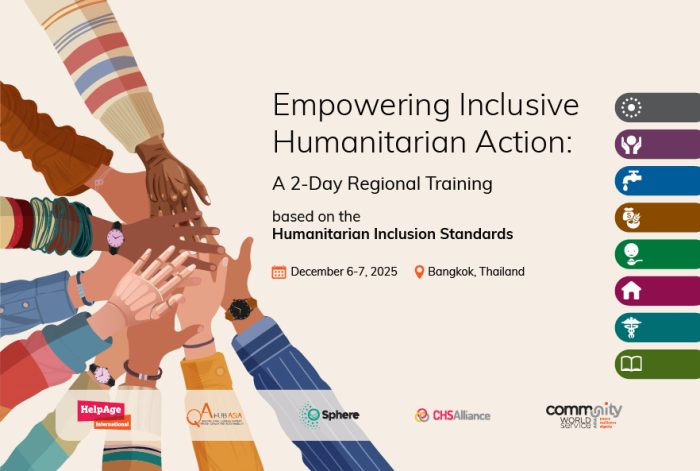
Join us for a transformative 2-day regional training designed to strengthen age and disability inclusion in humanitarian response. Based on the Humanitarian Inclusion Standards(HIS) and aligned with the Core Humanitarian Standard (CHS) and Sphere Handbook, this training equips participants with practical tools to ensure no one is left behind.
When: December 6–7, 2025 Where: Bangkok, Thailand Organised by: HelpAge International & Community World Service Asia (CWSA) Fee: USD 250 (National/Local Organisations), USD 300 (International Agencies)
Why This Training Matters
In the face of overlapping crises, from climate shocks to conflict, older people and persons with disabilities are often overlooked. This training introduces a proven framework to embed inclusive practices across humanitarian programming.
What You’ll Gain
Participants will:
Understand the importance of age and disability inclusion in emergencies
Apply the nine HIS standards across program cycles
Use the Age & Disability Organisational Assessment Tool
Strengthen inclusive practices within their organisations
Who Should Attend
Ideal for Inclusion Advisors, Programme Managers, Technical Coordinators (Protection, Health, Livelihoods), and MEAL staff. Full attendance and commitment to sharing learning are required.
Community World Service Asia is hosting a QAS in Action: Putting Principles into Practice regional workshop, taking place from December 4–7, 2025 in Bangkok, Thailand.
This 4-day learning event is designed for humanitarian professionals committed to advancing Quality, Accountability, and Safeguarding (QAS) in their work. Whether you’re a QAS focal point, programme manager, safeguarding lead, or local NGO leader, this workshop offers a dynamic space to strengthen your leadership, share good practices, and co-create practical tools for smarter, safer, and more accountable aid.
Why join?
Deepen your understanding of QAS principles in real-world settings
Learn mentoring techniques to multiply good practice