
A Stoicism named Hafeezan
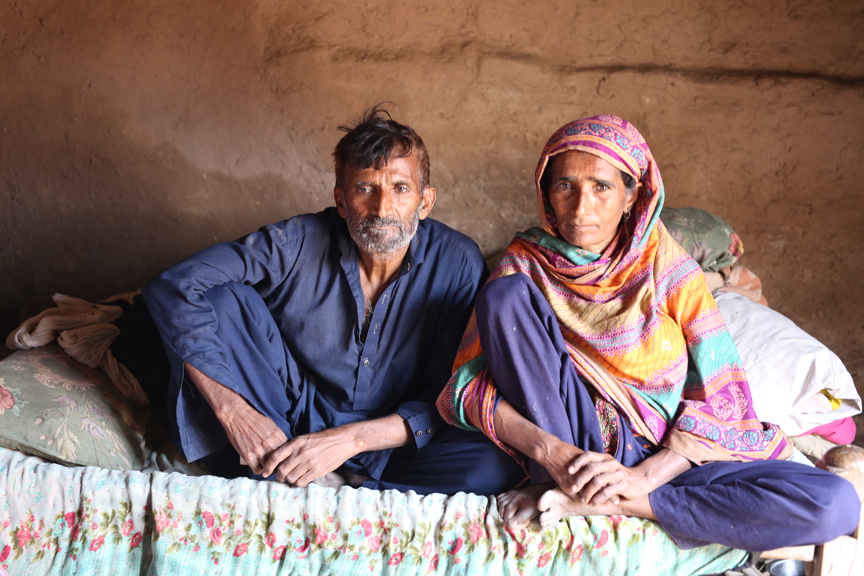
Hafeezan has a look of sharp stoicism on her calm face. This may be because she is reconciled to a life of adversity. The only time bleakness shows through is when she speaks of her husband, Ramzan’s blindness. At this point Ramzan speaks up, “Ten years ago, I had trouble with my eyes and the doctors in the government hospital told me my eyes’ battery is discharged,” he says as he pats the back of his head to indicate the location of the ‘battery’. He appeared to have misunderstood the medical explanation he had been given, interpreting the reference to damaged brain cells as a “battery” in the back of his head that could no longer be recharged. Today he can just barely see shapes and tell light from darkness. Despite this profound loss, he continues to face life with courage, supported by Hafeezan’s steadfast presence and their shared determination to endure adversity.
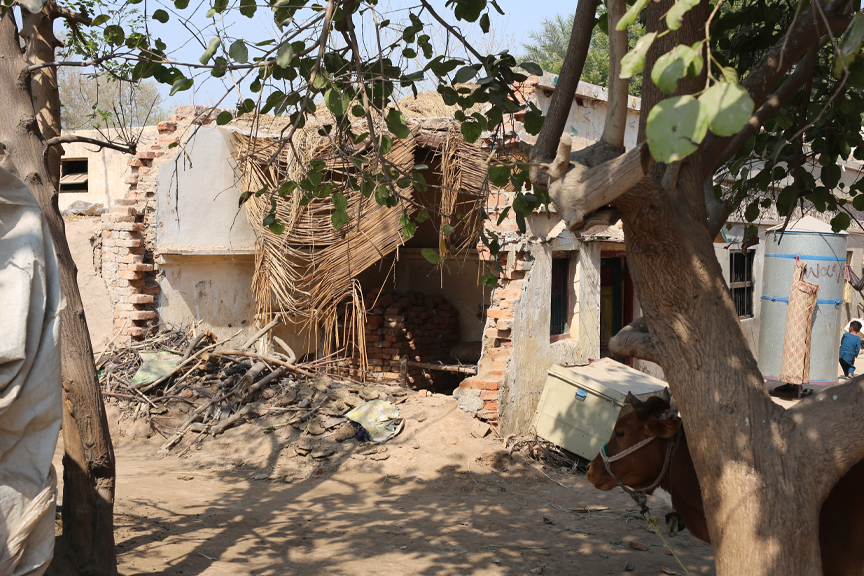
The couple lives in Village Maulvi Wallah. It lies about five kilometres south of Muzaffargarh city centre and about two kilometres southwest of Rohari. All around are neatly parcelled blocks of agriculture and thickly growing mango orchards. Maulvi Wallah is comparatively better off than many surrounding villages, with brick and concrete houses clustered at its center and a government school where both boys and girls attend regularly. Yet, while younger generations are gaining access to education, many elders remain without formal schooling. Despite these modest improvements, poverty continues to affect most households, shaping daily life and limiting opportunities.
Before losing his sight, Ramzan worked as a factory labourer in Muzaffargarh, earning what he recalls as a fair wage. Together with Hafeezan, he raised a large family of seven sons and four daughters. Despite their hard work, limited resources meant they could only construct a modest mud and wattle home.
As their sons grew older, they began contributing to the household income, but soon many married at a young age. Reflecting on this, Ramzan notes with quiet resignation that once children start their own families, parents can no longer rely on their support.
One son, Faiz ul Hasan, lives with them. Though married, he and his wife have no children. Faiz bears visible scars on his face and hands from severe burns sustained in childhood. At the age of five, while imitating his mother as she poured kerosene into the kitchen stove, he accidentally added fuel while the fire was still burning. The sudden flames engulfed him, leaving lasting injuries despite urgent medical care.
Today, Faiz continues to live with the physical marks of that accident, yet his presence in the household is a source of strength and companionship for his parents. He works at a brick kiln shaping the wet clay in the wooden moulds. He says he can mould 700 hundred bricks in an eight to nine hour workday for which he is paid Rs 1000. But that does not make life any better for he goes to work only two days a week. He says his burn-damaged hands ache after a long day of work and he has to take the break. The couple’s youngest son works as a helper in a general merchandise store and brings home Rs 200 every day to make things somewhat better.
For families like theirs in Muzaffargarh district, hardship is not limited to poverty alone. South Punjab is no stranger to climatic extremes. Older residents remember drought; younger generations recall either the dry years of the mid-1990s or the devastating floods of 2010 and 2015, when livelihoods and agriculture were badly affected.
So when government agencies announced evacuations in August 2025 for villages near the Chenab River, many assumed it would be another event like 2015, disruptive but manageable, with no more than ankle-deep water entering the villages. Instead, the flood exceeded all expectations. Houses built of mud or sun-dried brick collapsed within hours once the water rose to thigh height. The force and speed of the floodwaters left families with barely enough time to save the most essential belongings.
Like everybody else in the village, Hafeezan and Ramzan left their home in the flood to take refuge on the flood protection embankment. They were fortunate to receive a tent from the government and that made life a little better. Ramzan says when the water rose, they had 600 kilograms of wheat grain in the house, which was their primary concern. The other very important part of the family was the heifer that Hafeezan tended on adhal1. Were she to lose the animal to the waters, she would have had to make good the value of the animal for the owner. And so they lost most of their bedding, clothing and kitchenware.
Five weeks later, their return was not to the home they had known, but to a heap of clay, timber and household items smashed under the fallen timbers. According to surveys, some 500,000 persons were displaced in Muzaffargarh district. Of these, the majority living in poorly built semi-permanent structures lost most of their household effects.
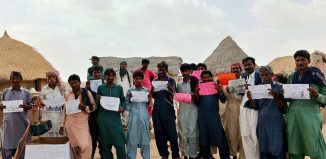
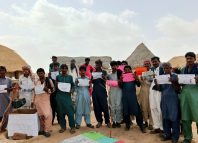
The humanitarian assistance provided by Community World Service Asia and its partner, Japan Platform (JPF), ensured provision of non-food items to households most severely affected by the floods which offered families vital relief and a chance to rebuild their lives with dignity. Each package, designed to meet the needs of an average family of seven (in line with Sph) included essential items for warmth, cooking, and daily living: blankets, foam mattresses, plastic mats, cooking pots with lids, serving utensils, cups, plates, a kettle, food storage containers, and basic kitchen tools.
Despite his poor eyesight, Ramzan began rebuilding the mud structure with the help of his son Faiz ul Hasan. And so, before the cold weather set in, the family was able to move from the tent to this shelter. But for the two unmarried daughters, and four sons still living with the parents, it was a tight fit. Fortunately, their two older sons had brick and mortar rooms that had survived the flood and the family shared accommodation.
Grateful for the bedding and kitchenware she received, Hafeezan shared that the support spared her from a significant expense, one that would otherwise have forced her into debt. Now she waits patiently for the heifer to be ready to mate. She believes it will happen by the end of 2026. Then by selling the milk and caring for the calf, she might be on her way to becoming a livestock owner. Meanwhile, it is a long, hard grind for the family. Until then, life remains a long and difficult grind. But Hafeezan endures it with the same quiet resolve.
- The ‘Adhal’ (or sometimes referred to under similar sharing, partnership, or nomadic grazing terminology) system in rural Pakistan is a traditional livestock management arrangement where ownership and caretaking responsibilities are separated to maximise resources, typically for cattle, buffaloes, sheep, or goats. It acts as a socioeconomic support system for poor households and smallholders, allowing for the herd management of small numbers of animals ↩︎